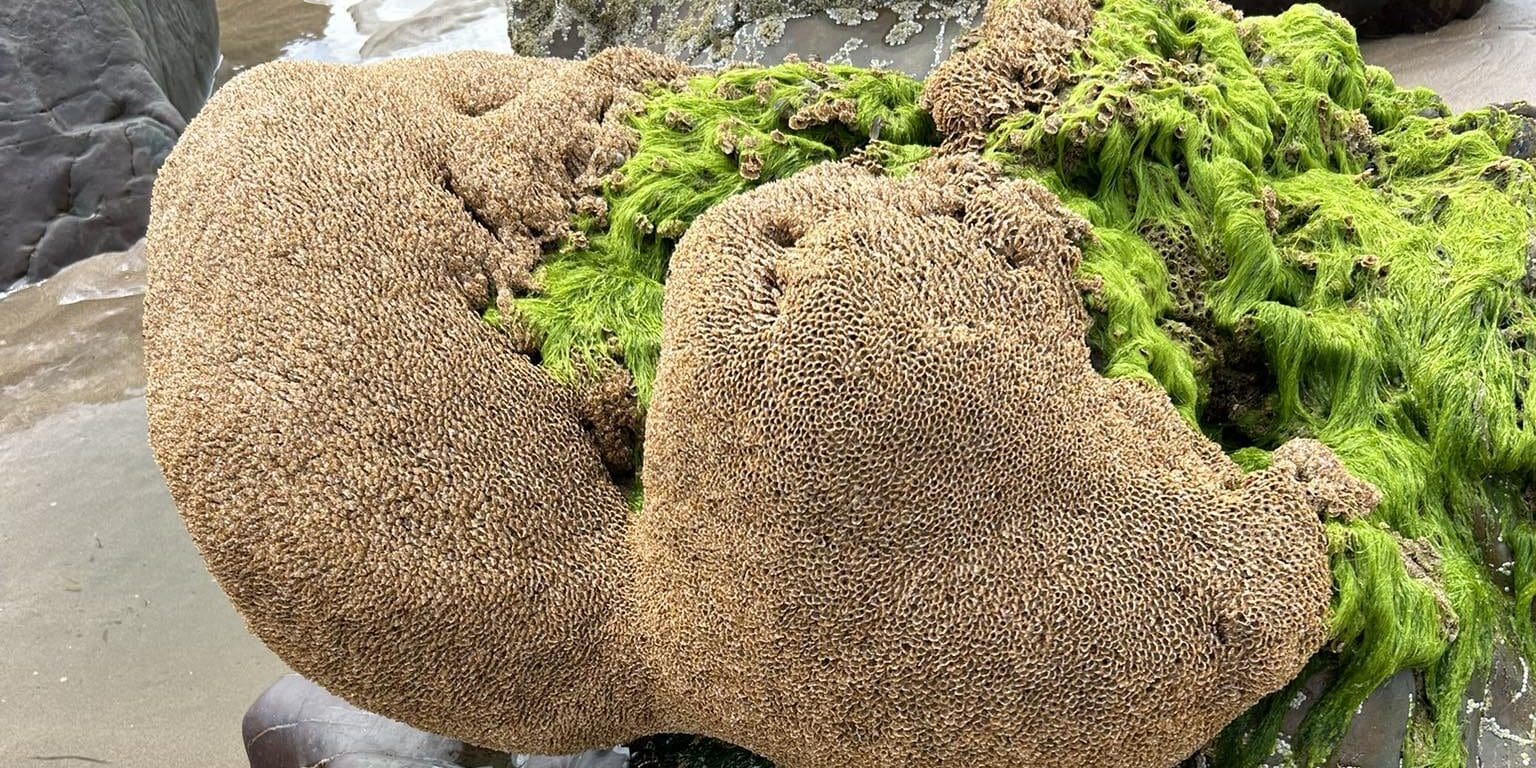
The honeycomb worm, Sabellaria alveolata
Honeycomb worms (Sabellaria spp.) are tiny worms that live around the low tide area of the beach. They build tubes, attached to the rock to live in and the structures we see on the beach are dense colonies made up of thousands of individual worms. Fully grown, each individual worm is around 3-4cm. The colonies however can often cover large areas of rock, forming solid reefs.
They are found all around the U.K’s coastline, predominantly on the western coast. The worms need a moderate amount of wave exposure in order to feed and form reefs so we tend to find them on beaches that aren’t too sheltered, which is exactly the habitat that North Cornwall provides. This is why they are so common on the beaches around Bude.
Why do they create tubes?
Honeycomb worms are soft bodied and feed by filtering organic particle matter out of sea water. The appendages they use to filter the water with are called branchial crowns. These appendages are incredibly delicate so require protection from wave action. The worms achieve this protection by constructing tubes to live in, made from grains of sand. In Fig. 2 you can see the soft branchial crowns, shaped like fans that beat in the water and filter out suspended particles for feeding or building.
Why do they form colonies?
The worms build their tubes on top of each other, which grow with the addition of more and more worms until a colony is formed. The honeycomb structure of the colony gives the individual tubes strength and gives protection from wave action. This structural strength enables the worms to be attached perpendicular to the rock in order to feed in the water current.
The structure of these colonies is very similar to coral reefs found in the tropics and in the same way as coral reefs they too support an increase in biodiversity, with animals such as anemones, snails, shore crabs and seaweeds using the colonies for shelter.
Are they under threat?
Storms and cold weather can kill off the worms and humans can pose a threat in the form of building sea defences, farming mussels, pollution and trampling. They have been recognized by the U.K’s Biodiversity Action Plan (BAP) as a priority habitat and they have been included in Special Areas of Conservation (SAC’s) in Wales. Please see the further reading for details on these management plans.
The big way that we can help protect them on the beaches in the U.K is simply to avoid trampling the colonies!
When you walk on the reefs you crush the fragile tubes made from sand and can kill the worms contained inside.
So next time you are on a beach in Bude have a look at the low tide zone for these incredible honeycomb worm colonies, just make sure not to step on them! The best examples are found at Duckpool, Northcott and Crooklets. Please check tide times and check with the lifeguards if you are unsure.
Author: Joe Weghofer, a graduate of Marine Biology from Bangor Univeristy.